
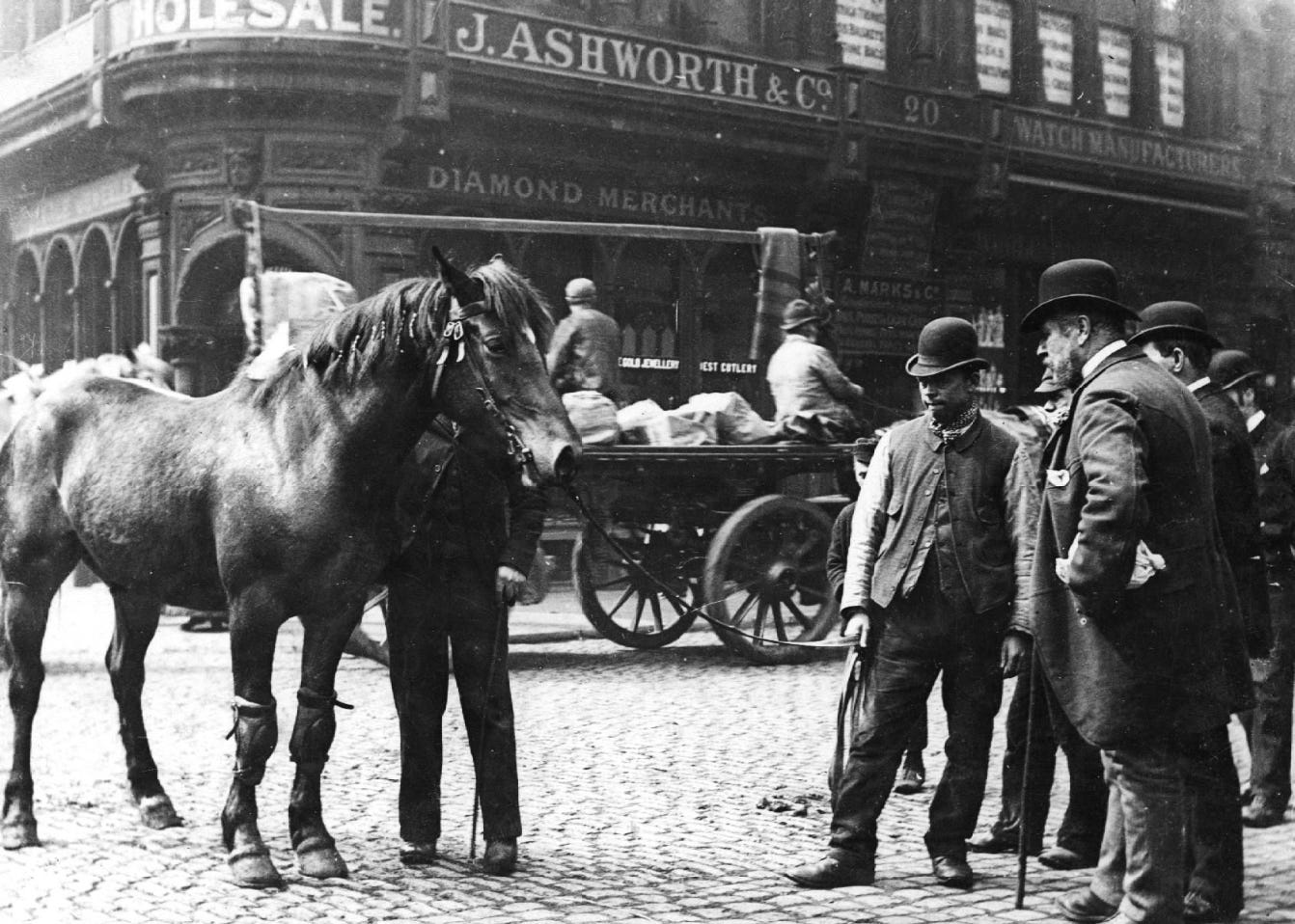
The Northern Quarter is one of Manchester’s trendiest districts today but in the Victorian era it was awash with secret gambling clubs.
Thomas Street was the “headquarters” of the betting nuisance in the city, according to the great Manchester detective Jerome Caminada.
At a place called Tattersall’s, just off the street, a “great concourse” of people gathered every day to fritter away their hard-earrned wages.
The clubs there and in other parts of the city were being blamed for ruining families and causing young lads to get involved in crime.
Among the warehousemen, porters and mechanics placing bets were the wives of other workers and boys who should have been at school.
In May 1885, Manchester’s chief constable decided to take action and order 400 police officers to carry out lightning raids at 23 clubs across the city.
Even experienced police officers were shocked by what they uncovered.
Led by Caminada, the officers had to act fast because most of the club owners had phones and telegraphs could use to warn each other about the raid.
The first clubs the police entered were called the Rous and the Falmouth in Macdonald’s Lane — a total of 170 officers going inside or watching the doors.
Business was in full swing at the tables.
“We found upon the premises over 200 men,” Caminada later wrote, “and a fearful scene ensued as we entered.
“Seeing me coming they closed the door, and, as they refused to open it, I broke it open.
“There was a general scramble on the part of the betting men to get their betting books, money and other articles out of sight, and on the part of the members to get out of the place.”

As the police pushed their way up a spiral staircase leading to the Falmouth Club, the gamblers were rushing down.
Some jumped from the top of the stairs to the bottom over the heads of the officers.
One man, a commission agent named Herbert Jackson, jumped on to the skylight above the Rous club, fell through the glass and then leaped out of a window.
He received such a terrible cut on his calf that he had to be taken to the infirmary by two constables.
Other men ran across the skylight and across to the Falstaff Hotel — breaking more glass and suffering further cuts.
“Nearly all the windows in both clubs were smashed and for a quarter of an hour the scene was one of indescribable confusion,” the Manchester Courier wrote.
Caminada jumped onto the bar and shouted out that he only wanted to arrest the bookmakers and not the punters.
It was only then that the chaos stopped and the police were able to march the gambling bosses to Manchester Town Hall.
“By this time the whole city was roused and became alive as to what was going on,” Caminada wrote.
“As I and my colleagues went from club to club, arresting the leading men and sending them to join their companions at the town hall, we were followed by a large crowd shouting, cheering, yelling and making as much noise as possible.”

At the Palmerston Club in Ardwick, a notorious criminal jumped through the window and made his escape.
Nearby at the Pin Mill Club, a dirty little place nearby with scarcely room for a dozen men to turn around, the husband of a woman in charge of the bar left her and fled with the words: “Never mind, lass, it’ll be all right.”
Another club raided that day was the Devonshire, which was over a stable and could only be entered by a wooden stepladder from a store house.
It was a favourite secret den of the wives of working men in the neighbourhood.
“The director, bookkeeper, secretary and treasurer all combined in one big Falstaff-proportioned man, who had evidently fattend on his gains,” Caminada said.
The club had 370 members who paid an annual subscription of one shilling each. Other clubs were found to have up to 700 members on their lists.
Some of the bookkeepers refused to walk to the town hall with the police in handcuff and ordered taxi cabs to take them — sitting in the back with an officer.

At the Lancashire Club off Hyde Road, a gbnd played Auld Lang Syne as the cabs drove up.
Caminada was shocked to discover that there were more than 2,000 people in the clubs he had raided that day.
About 200 bookmakers and club staff including directories, secretaries, barmen, doorkeepers and bookmakers’ clerks were arrested in total.
The police recovered £2,200 from their trouser pockets — worth around £250,000 today.
The Courier described it as “the great raid”, adding that the likes of it had never been known in the history of the city.
Other clubs listed in court reports include the Burton, the Stanley, the City, the St George, the Russell, the Derby, the Gaythorn Social, the Waterloo, the Central and the West End. Then there was the Bentinick Club which was opposite the Assize Courts next to Strangeways prison.
In the Central Club, in Back Lad Lane, off Deansgate, Caminada found 70 men including three “very horsey looking bookmakers”.
The club was a resort of rough characters and consisted of a large room, open to the roof, with a dirty sawdust floor and a ricketty billard table. The punters had “smoked the air blue” by the time the police smashed through the door.
The leading bookmaker was a lad nicknamed Young Cheeky.
Before going away with the police officer, he helped himself to a thick cigar and a drink, and tucked a meat pie under his coat.
But the end of the day, people had begun to turn on the officers who were disrupting their gambling.
When they raided the Albert Club off Oldham Road a huge crowd was waiting.
“The whole of the people around this neighbourhood seemed to have turned out of doors and expressed a good deal of sympathy for the men in charge and a great deal of ridicule for those who were depriving them of their neighbours,” the Courier said.
“Thousands of people lined the footway and a number of youths threw mud at the cabs as they passed by.”
♠️♥️♣️♦️
Thank you for reading…
I hope you enjoyed this week’s true story from the backstreets of Victorian Manchester.
If you do enjoy it, please do subscribe here as it genuinely helps me to devote the time to keeping it going. It takes me at least a day to research and write it each time I post. You can unsubscribe with one click.
I find it fascinating how areas of the city have their own history that most of us just don’t know about.
How has your week been? I’ve been busy this week.
On Monday, I took a group of 16 people from Cadishead and Irlam to Manchester Central Library where we had a tour of the archives and did some family history research on the library’s computers.
It’s part of a six-week genealogy course I’m teaching for a charity called the Hamilton Davies Trust.
I’ve also been preparing this week for my Angel Meadow tours. Tickets are already selling quickly. If you’re thinking of coming along, you can see the dates and prices on this link or clicking on the image below.

Have a great weekend!